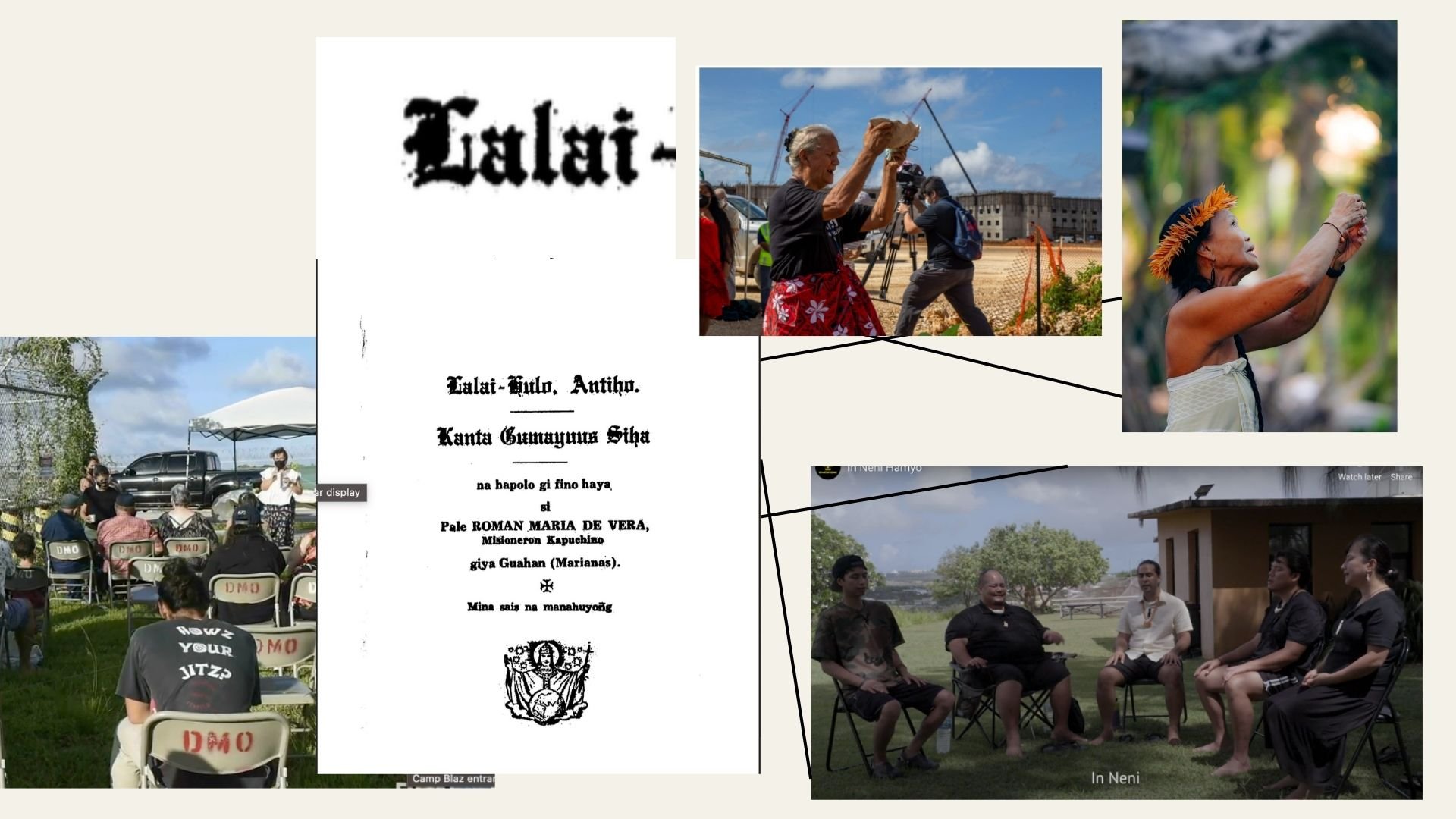
While lålai oftentimes refers to a repertory of hymns steeped in Chamorro Native Catholicism, Chamorros adapted and facilitated the transition of chanting known as lålai in ways that maintained Indigenous vitality even as it entered Catholic invocations. When connecting this history with current resurgences of lålai, it is challenging to isolate normative principles for creating musical objects that reify it as a discrete genre. That is, because of its wide application and thus musical indistinguishability, lålai emphasizes the voice whether understood as music, language, or narrative. Lålai activates not just ear listening, but rather that which generates its own process of listening, which is key to maintaining Indigenous relationships to their environments.
Sabånan Fadang
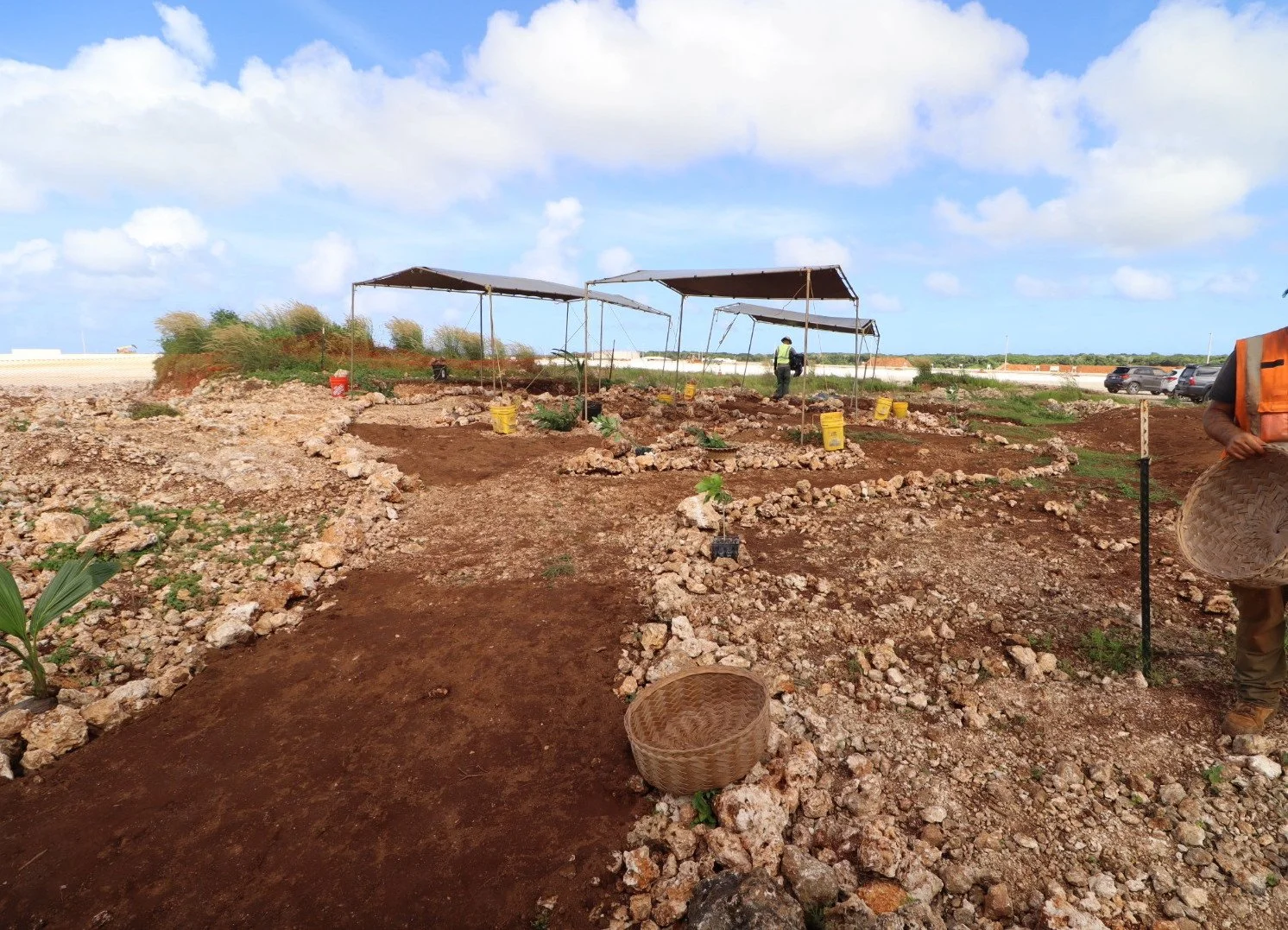
Image and recording courtesy of Rudy Rivera
I tinituhon, I tinituhon, in the beginning
Tåya guaha, there was nothing
Na i mina’lak yan i hinemom, light and dark
Yan gi entalo i mina’lak yan i hinemhom, and in the spaces of light and darkness
Guaha hugua Yu’os taotao, There were two human gods
Si Fu’una yan si Puntan, si Fu’una yan si Puntan
Sa’ manYu’os Taotao
Ma tungo na u ma gu’tos i ha’ånen-ñiha
Ya annai hihihot, hihihot
Si Fu’una, annai ma tungo na u ma gu’tos i ha’ånen-ñiha
Kumasao taihinekkok
Yan i lago i atadok-ña
Mama’tåsi, annai ha li’e i masåmain i tasi
Ilek-na, Puntan Puntan Puntan my brother
An matai yu hoggue yu ya un po’lo yu gi apaga-mu
Ya un yagua i tataotao-hu gi hålom i tasi
Ginen I lago-hu
Fu’una humålom gi tasi
Lao ti apmam kumahulo I mamataiguan na tataotao-ña
Yan mama’tåno ni mafa’na’ån Guåhan
Gi akagui na atadok-ña “ha fatinas i pilan”
I agapa na atadok-ña Ha dagao ni sumenkattan
Ya mama’ I atdao
Ha chuli i kannai-na ya ha satpi hulo gi langet
Ya mafatinas ni titufongon na pution
Fu’una yan Puntan
Mahålang si Puntan
Ya matai lokkue
Yan I lago I atadokna
I gaga I manglo
I gaga I tasi
I tinanom
Yan I taotao Guåhan
I manchamorro
Ni managa ya ma soda i tano-ta giya Guåhan
I tinituhon
I manmo’na na taotao
Ni manmahafot
Gi tano
Ni sinantusan
Fu’una yan Puntan
“Kulo blows”
More than a popular recreation beach or wildlife reserve, the ancient village known as Litekyan roughly translates to “the stirring place” in the Chamorro language. Litekyan is a sacred ancient village in northern Guåhan (Guam) that holds immense cultural heritage and endemic ecological life. Litekyan has been at the center of Land Back movements between the U.S. military and the original landowners and descendants. The following is one account of a reinternment ceremony that took place at the ancient village of Sabånan Fadang, just above Litekyan in what is known today as MCB Camp Blaz.
Cultural performing arts group På’a Taotao Tåno’ sounded a chorus of kulos (conch shell trumpets) that permeated the air above the baren land of the recently bulldozed 1000 acre limestone forest. In that moment of sounding, the kulo’ blowing emphasized Indigenous movement, knowledge and returning to land. Such chorus does more than signal the sounding of ceremony, and also raises fundamental questions of Indigenous belonging in relation to the absented hålom tåno (jungle). The ceremony and particularly the chanting therein attempted to suspend an area overrun with new kinds of acoustic inhabitance. That is, the spatial arrangement, the thick vegetation that once saturated endemic life but also absorbed the noise of heavy car traffic on Marine Corps. Drive. was no longer there. Majority of the ecology was replaced by the hum of construction inside the newly erected Marine Corps. Base Camp Blaz. This would be the beginning of a new litany of sounds of the everyday throughout this vast acreage and more broadly for the island of Guåhan and the Mariana Islands. On multiple fronts by land, air and sea, the sounds of platoon soldiers shouting, the rapid fire of ammunition in the live-fire training range complex, or the frequent sonic booms from overhead aircraft formations in joint military exercises all seem woefully incommensurable with two kulos blowing in ceremony. The subsequent chanting of the creation story of Puntan and Fu’una that stories the birth of the CHamoru people that held the sacredness of the land together was now awkwardly out of place as it juxtaposed the military pomp that now occupies the space well into the future.
As soon as the kulos ceased to sound, På’a Taotao Tåno’ led all attendees with Ma’lak na Puti’on Tåsi, a lålai (chant) that invokes returning to land from maritime travel and is frequently sung at a matai[1] (funeral). While I can imagine what this particular ceremony was like, this passage I have described above is a memory not wholly my own. I, as with many island residents could not attend due to military access restrictions, and were not notified of the ceremony until it ran in media news outlets. However, I often frequented the cliffside leading down to Litekyan, and so I had already possessed a general sense of the area where the ceremony took place. I also knew the music that they used because it was also used in my own family funerals and other occasions of island life that shaped my upbringing. The kind of mourning was familiar as I conversed with cultural performing arts practitioner Rudy Rivera, who attended and helped facilitate the ceremony. This dialogue and intimate past experiences gave me the patchwork needed to piece together the acoustic situation, the music, and how listening to Indigenous survival unfolded as the ceremony worked to appease desecration. Rudy Rivera provided me with the audio recording of the ceremony and informed me in detail of how it unfolded. The limited civilian access is an indicator that while the military makes a clear distinction of what is inside and outside the base, sound cannot be so easily contained in the same way of human movement. From the sonic fallout of military activities, to having recordings of sound and music-making inside the military fence shared with me —sound’s porous nature knows no borders; they are indiscriminate in how their energies escape containment, thus creating possibilities for people to learn—via sound—what impacts are occurring even though such areas are unreachable. The ways in which music and ceremony decry the wanton ecological and cultural destruction is something that without putting into words, simultaneously makes clear the importance of how Indigenous peoples still recognize a responsibility to fanmalak i manmåtai (go to the dead) and care for ancestor.
Chanting as it is taught and passed down, is a way of knowing that fastens tight the interconnectedness of genealogical ties to Indigenous Pacific Island worlds. It is precisely why I focus on sound and music as more than perfunctory motions, as an arena that I pay more attention to as a formidable resource and reservoir of ancestral wisdom. Tapping into chanting practices and music-making is how Indigenous ceremony, cogently intersects with ecological crisis as a form of citizen-documented sound such as the instance of Såbanan Fadang iin the recording above. As such, chanting works as a kind of oversight that recognizes what people feel at the level of sound’s multi-modal qualities. It cannot be fully describable in words alone, which is the sense I got when Rudy had shared his experiences that day. The emotional sentiment he could not express in words was what his recording offered to me each time I listened to the chanting and collective singing contained in it. To put it in Martin J. Daughtry’s terms, I could still intimately relate to the inner concentric zone of trauma where the ceremony took place in relation to the outer audible/inaudible zone of wherever I was that day. These zones provide a structure to the everyday felt experiences inside and outside the fence. Rudy’s story and others corroborate the scale of environmental degradation and public upheaval on a level of Indigenous sonic knowing. Such a way of knowing is a crucial aim of my contribution to the Ta Nå’i Ånimu Exhibition as I constantly follow how music can in the Chamorro vernacular, na’huyong (which literally means to ‘make come out’), create Indigenous vitalities into space even as the life-worlds that gave rise to these chants are becoming unrecognizable. In the absence of environment and the unearthing of ancestor, the insistence on healing and life is how music is essential in understanding an island world confronted with multiple forms of assaults. This installation seeks to interrogate such events on the plane of sound knowledge as it is distributed in Indigenous performing arts practices.
[1] Literally means dead in CHamoru/Chamorro.